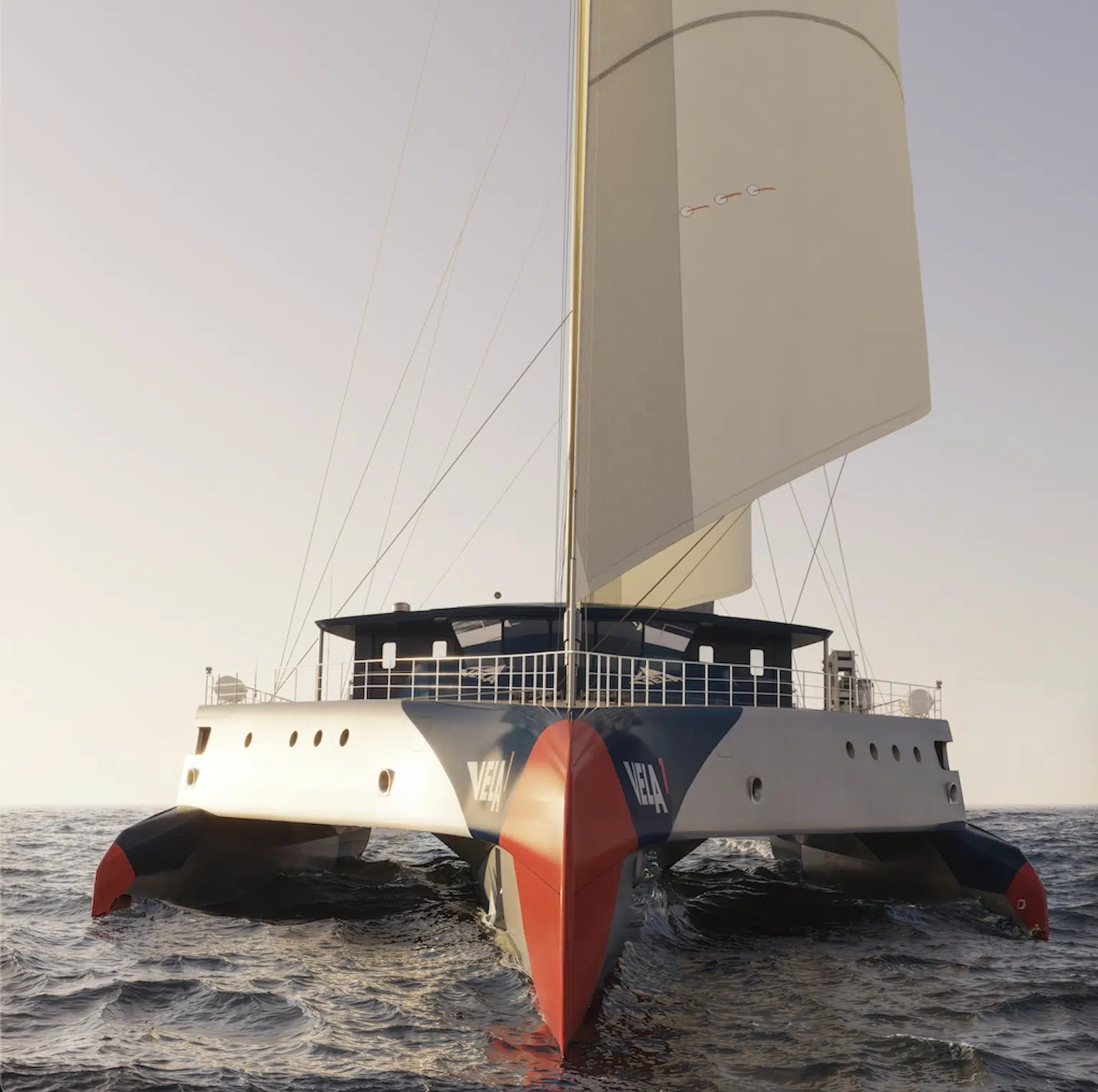

VELA is often discussed through the lens of performance—and for good reason. Aligned with the needs of shippers, the speed of our sailing cargo ship offers a low-carbon alternative to air freight and conventional maritime transport.
Optimized both in port and at sea, speed is not an end in itself, but a means to strengthen the core of our mission. Cargo integrity and transport resilience are what truly drive our innovations and shape our naval, logistical, and strategic choices. Vessel robustness, port security, cold chain continuity, supply chain reliability, crew safety—these are the issues at the center of our attention.
Sailing under the French flag: a structuring commitment

Certified by Bureau Veritas and compliant with all international conventions of the IMO (International Maritime Organization), our 100% wind powered cargo ship sails under the French flag. Recognized as one of the most demanding in the world, the French flag is a benchmark for maritime safety, as illustrated by France’s first-place ranking in 2025 within the Paris Memorandum of Understanding, where it has consistently remained on the white list.
These high standards govern vessel design, operations, and life on board, ensuring a high level of safety for both crew and cargo. They make the French flag a strong guarantee of a sailing cargo ship adapted to the demands of the 21st century.
Security starts on land
Storage and handling phases are among the most vulnerable links in global supply chains—particularly in large, congested port hubs, where extended dwell times multiply risk exposure.
Worldwide, cargo theft remains largely underestimated, despite a sharp increase in recent years (Njiru et al., Trends and Patterns of Cargo Theft, IJRSSH, 2025). In the United States, this trend recently led the American Trucking Associations to alert Congress, citing annual losses of up to $35 billion across the supply chain.

In response, VELA has chosen to operate from secondary ports. Less congested, they allow us to reduce storage times and deploy our own secure warehouses directly by the dock. Loading, unloading, and handling operations are carried out by VELA teams using our onboard crane.
Below deck, our cargo holds provide optimal conditions for pallet handling and securing. By controlling the interface between land and sea, VELA strengthens the continuity and security of the entire transport chain.
VELA: a strong link in the cold chain
On board VELA 1, the transport of temperature-sensitive goods sets a new operational benchmark at sea. Built to safeguard cargo integrity, the sailing cargo ship ensures continuous temperature control through two refrigerated holds (2–8°C) and five temperature-controlled holds (15–25°C).
Developed with our partner T.R. Équipements, the Coolsafe by VELA cooling system meets the most stringent standards of the cosmetic, pharmaceutical and food industries. Unlike conventional solutions, where performance largely depends on container fill rates, VELA guarantees precise temperature control at the pallet level—ensuring thermal stability even for partial loads.

From the very first voyages, highly sensitive and valuable cargo — including plasma — will be transported safely. A major innovation: this performance relies entirely on renewable energy.
At sea: the calm of a warehouse
Once at sea, with VELA, cargo spends some of the safest days of its entire journey. Palletized transport, the trimaran design, and our watertight, secure holds are key advantages that ensure its safety.
Each year, although marginal relative to global traffic, thousands of containers are lost at sea. The rolling motions experienced by container ships — under certain not uncommon sea conditions even leading to the extreme phenomenon known as “parametric rolling,” where oscillations reach critical amplitudes — combined with high container stacks stored on deck, are significant contributing factors (Transportation Safety Board of Canada, Parametric Rolling, July 31, 2024).
By contrast, the structural qualities of the trimaran, with its wide stance across three hulls, enable a stable crossing regardless of sea state. There is no risk of losing pallets overboard: they are protected from the elements, stored deep within the vessel, below deck.
“What about weather risks?”
They are at the heart of our expertise. VELA operates on a maritime route where weather systems are among the best understood and most predictable in the world. Drawing on offshore racing experience, we transfer advanced weather-routing technologies and proven know-how in anticipating sea conditions.

As François Gabart, co-founder and Head Sailor at VELA, explains:
“We focused on the North Atlantic, a route and a weather zone I know well, where forecasts are very reliable. There are places where there is little or no wind, but today we know where they are—and how to avoid them.”
The trimaran design allows the cargo ship to maintain strong speeds even in very light air. Its overall speed also enables effective positioning relative to low-pressure systems. The most severe conditions — those that could require waiting in port — would impact conventional shipping as well. In any case, the vessel is equipped with storm sails and engineered to withstand the extreme forces of the ocean.
Robustness built into the vessel’s DNA

VELA was born from offshore racing — a world where performance is not measured solely by speed, but by the ability to reach the finish line. At VPLP and MerConcept, the engineers and naval architects supporting us specialize in finding the right balance between performance and robustness.
In commercial shipping, that balance shifts: robustness is non-negotiable. The trimaran’s structures and mechanical components are dimensioned and reinforced to absorb extreme loads, and to endure repeated crossings over time. On this foundation of strength, a culture of controlled performance takes shape — allowing the vessel to sail fast, over long distances, and in optimal safety.
Supply chain sovereignty and resilience
VELA approaches maritime safety beyond the risks strictly associated with freight operations. Our mission is to bring resilience to both businesses and society as a whole.
In a context marked by volatile energy supplies and geopolitical instability, dependence on fossil fuels represents a major vulnerability. By harnessing wind — an abundant, renewable, and sovereign energy source — 21st-century wind powered cargo ships offer a concrete pathway to reducing that dependence as much as possible.