


it’s time
to reinvent international shipping
Here, we share our footprint, our standards and the team driving the change we want to see.

OUR vision,
“Reinventing international shipping by drastically reducing its impact.“
Our philosophy: To transport better, we must respect the sea, the land, people and our customers.
We aim to transform global shipping into a positive force for the planet, radically reducing emissions and social impacts associated with global supply chains. We envision a world where wind-powered navigation is once again the standard, connecting continents in a robust, sustainable, and equitable way.
“Our belief: The wind moves the world.”

“We provide businesses with 100% wind-powered ocean shipping”
OUR mission,
“ Making the ocean the most
sustainable place for freight. ”
We provide businesses with 100% wind-powered ocean shipping that is reliable, high-performing, and minimizes planetary impact – guaranteeing lasting efficiency.
Our mission is to deliver advanced logistics solutions, combining the power of wind with cutting-edge technology to offer sustainable, fast, reliable, secure and economically viable maritime transport. By redefining industry standards, we aim to prove that performance and sustainability can go hand in hand.

OUR footprint
“Navigating beyond appearances:
Our approach to reducing your impact”
To achieve this, we are rigorous, precise and transparent in measuring your logistics footprint.
This means thorough analysis, concrete data verified by trusted third parties, and an unwavering commitment to continuous improvement.
Because what isn’t measured can’t be improved.
We have conducted a full life cycle analysis of our solution, and our vessels sail under the French flag.
Because what isn’t measured can’t be improved.
Key Supply Chain
Challenges
Security
65%
65% of cargo theft and loss incidents in international shipping occur at sea.
Price Stability
400%
Freight costs have increased by more than 400% in just two years.
Reliability
80%
80% of companies MENTION reliability as a critical factor.
Delivery Times
32%
Only 32% of vessels arrive on schedule.
Cargo Integrity
40%
40% of ocean freight fails to meet required temperature standards.
ESG and Reporting
Challenges
ENVIRONMENTAL
impact
Greenhouse Gases (GHG): GHGs like carbon dioxide (CO₂), methane (CH₄) and nitrous oxide (N₂O) trap heat in the atmosphere and drive climate change.
Global Transport Impact
25%
TRANSPORT ACCOUNTS FOR ONE-QUARTER OF GLOBAL GHG EMISSIONS
Maritime Shipping Impact
1000 M.
MARITIME SHIPPING EMITS AROUND 1,000 MILLION TONS OF CO2 ANNUALLY – ABOUT >3% OF GLOBAL GHG EMISSIONS
Air Freight Impact
600 M.
AIR FREIGHT EMITS APPROXIMATELY 600 MILLION TONS OF CO2 PER YEAR.
A Climate Emergency
17%
BY 2050, MARITIME SHIPPING COULD REPRESENT 17% OF GLOBAL CO2 EMISSIONS IF NOTHING CHANGES.
Other Forms of maritime pollution
Air Pollution
Ships emit pollutants like sulfur, particulates and nitrogen oxides, which can have severe health impacts.
Environmental Hazards
Toxic spills and wastewater discharges from ships threaten marine ecosystems and water quality.
Noise Pollution
Large-scale shipping generates significant underwater noise, endangering thousands of marine mammals.
Invasive Species
Ballast water from ships spreads invasive species, threatening local ecosystems and biodiversity.
Container Loss
Tens of thousands of containers are lost at sea each year, contributing to marine pollution and endangering wildlife.
SOCIAL impact
MODERN-DAY SLAVERY
25000
Approximately 25,000 cases of modern slavery are recorded in the maritime sector.
Flags of convenience
70%
of commercial vessels are registered under flags of convenience.
A Committed Company,
delivering real results

Are you looking to effectively reduce your environmental and social footprint? To achieve this, we are rigorous, precise and transparent in how we measure our impact. This means conducting in-depth analyses, providing concrete, verified data, and maintaining an unwavering commitment to continuously improving our practices.
“Our environmental and social impact, measured and proven.”
Our
Environmental
Impact Certified by

“To our knowledge, the climate impact of the VELA solution is lower than any other available mode of transport on a North Atlantic route.” Carbone 4 Consulting
VELA: Life Cycle Assessment (LCA)
The Only Effective Way to Measure Environmental Impact.
The Only Effective Way to Measure Environmental Impact
At VELA, we believe that to truly reduce our impact, we must first measure it precisely and comprehensively. That’s why we have adopted Life Cycle Assessment (LCA) as our core methodology for evaluating our environmental footprint – covering every stage of our value chain, from start to finish.
By considering emissions during use (the current scope defined by ADEME and the Smart Freight Centre), the VELA solution reduces carbon impact by up to 90% compared to conventional container ships on the transatlantic route, and by up to 99% compared to air freight.
LCA Results
VELA’s LCA results are third-party audited and demonstrate that our solution sets a new standard for low-impact transatlantic shipping.

vela’s
Commitment
We are the first maritime transport company to have participated in the French Business Convention for Climate (Convention des Entreprises pour le Climat). During this convention, we set our 2030 ESG roadmap and commitments.
Receive our 2030 Roadmap, validated by the CEC 2024:
Receive our 2030 Roadmap, validated by the CEC 2024:
Social Responsibility
in Maritime
Transport:
A necessity too often overlooked?
Is your brand truly ensuring that social standards are upheld throughout every stage of your supply chain – including the final step: transportation?
While more and more brands are making sure their products are manufactured under ethical working conditions, the transport stage is often forgotten. Yet, when you look closely at the data, it’s clear the industry is far from perfect. Maritime shipping is among the most affected by social issues, with thousands of seafarers working in unacceptable conditions – often under so-called “flags of convenience” that fail to protect their rights.
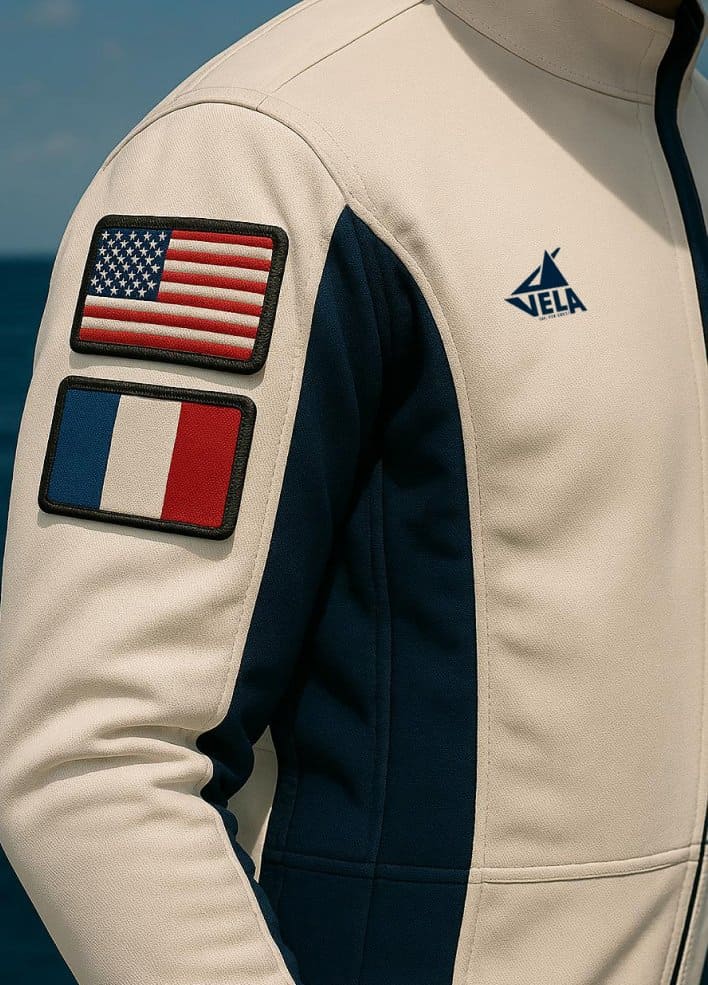
At Vela, we made a deliberate choice: to operate under the French flag, which enforces high social standards and guarantees respect for seafarers’ rights. We believe social responsibility cannot be separated from environmental responsibility. It is essential to ensure fair working conditions throughout the entire logistics chain.

Navigating a Changing
Regulatory landscape
International Maritime Organization (IMO)
The IMO sets the main decarbonization targets for the maritime sector:
- A 40% reduction in carbon intensity by 2030 (compared to 2008)
- Carbon neutrality objective by 2050
Key conventions include: MARPOL (pollution), SOLAS (safety), EEXI/CII (ship energy efficiency) → VELA already exceeds these targets by offering 100% sail-powered transport, with zero direct emissions.
International Aviation (ICAO)
Air freight also aims for carbon neutrality by 2050.
→ VELA provides a genuine alternative to air freight with a 99% reduction in impact, while matching the service standards of this sector as closely as possible.
1) EU Green Taxonomy
Classifies economic activities based on their contribution to the energy transition.
=> 100% wind-powered shipping is fully aligned, with no fossil fuel use.
2) ETS (Emissions Trading System)
Since 2024, shipowners must pay for CO₂ emission quotas, affecting freight rates.
=> With VELA: zero quotas, zero extra cost.
3) FuelEU Maritime
From 2025, requirement of a gradual reduction in the carbon content of marine fuels, impacting freight rates.
4) CSRD (Corporate Sustainability Reporting Directive)
Starting in 2025, CSRD mandates non-financial (social, environmental, climate) reporting for many companies.
=> VELA supports clients’ ESG strategies with precise data on logistics footprint reduction.
OUR team
The crew sails under the French flag.

OUR Financial Partners


“As an infrastructure investor for over 20 years, I was eager to support Vela from the very early stages of the project, in order to back a tightly-knit team driven by the same values of commitment that I stand for.”

Pascal Marty,
Co-founder of Atlante Gestion
“I support purpose-driven projects led by teams I truly believe in. All of those ingredients came together at VELA, and I’m proud to have been supporting them since their Series A.”
Benoist Grossmann,
Investor
Containers have been ruling goods transportation over the last 50 years.This choice was made for economic reasons but with a high environmental impact, just like air freight.
- #IMPACT: the weight of the containers (3 tons each) accounts for more than 20% of what is being transported on a conventional container ship vs. 2% for equivalent pallets (25kg each). Using pallets enables the transport of goods alone, without useless extra weight. Each pallet represents a reduction of 200kg in weight and the corresponding CO2 emissions.
- #STANDARD: we transport your goods in the same way they were initially prepared at your warehouse in French or US formats.
- #AGILE: You only pay for the goods we transport for you. There are no consolidation fees to compensate empty container management.
- #OPTIMISED: using pallets enables a vessel’s hold to be fully optimised and thus transport more goods than with containers.
We use very advanced weather routing techniques to define the optimal trajectory for each crossing. This allows us to avoid windless areas and areas where the wind is too strong.
These innovative cargo ships coupled with this routing allow us to be faster than conventional container ships (unloading included) on the Caen-New Haven route
It depends on the types of products and the palletizing plan.
We are up to 5 times cheaper than air travel.
For example, for a bottle of mid-range spirits, the additional cost represents a few tens of cents, compared to conventional sea freight.
At VELA, we practice “fair” prices for sustainable and socially responsible transport.