


Fossil fuels concentrate energy that is both dense and dispatchable. Wind energy, by contrast, is variable and diffuse. How, then, can supply chains built on predictability rely on wind-propelled vessels?
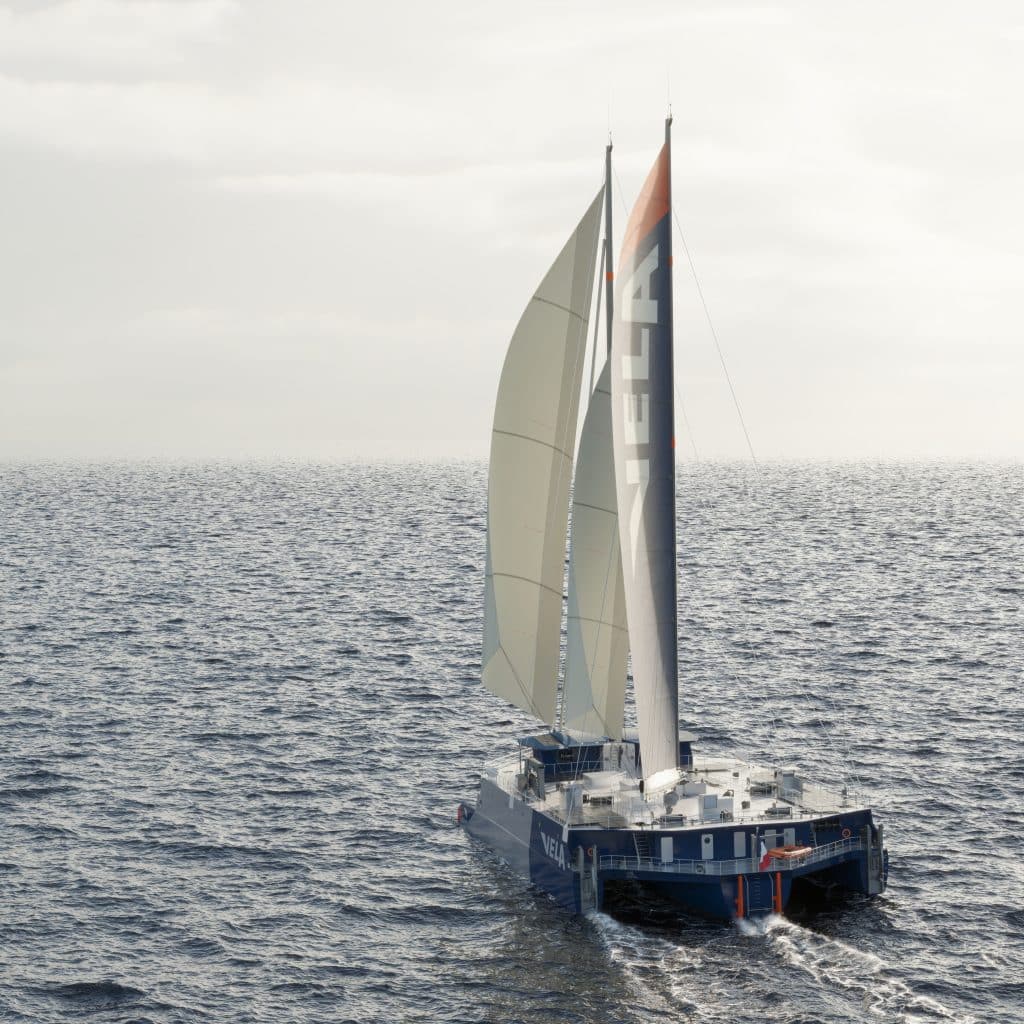
To ensure a regular service, VELA relies on three pillars: modern meteorology, routing expertise inherited from offshore racing, and the intrinsic performance of its trimaran cargo ship.
A maritime route well suited to wind propulsion
VELA operates in a meteorological zone that is both well studied and relatively predictable. The North Atlantic is structured around two major semi-permanent atmospheric systems: the Azores High to the south — a high-pressure system generally associated with stable conditions and moderate winds — and the Icelandic Low to the north, a low-pressure system linked to stronger winds and more unsettled seas.
Between them forms a pressure gradient that generates the prevailing westerlies — dominant west-to-east winds that are particularly steady in temperate latitudes. Further south, the trade winds blow consistently from the east across subtropical regions.
These semi-permanent systems create structured wind regimes whose relative stability has enabled transatlantic sailing routes for centuries. Because they directly influence the climate of Western Europe and North America, they are also monitored with exceptional precision.
A dynamic and complex system
The North Atlantic nevertheless remains a living system. Beyond its broad atmospheric structure, meteorological phenomena evolve constantly and across multiple scales. Conditions can vary significantly from one air mass to another. The general circulation of the North Atlantic is more complex than it may first appear.
Seasonality plays a major role. In winter, the Icelandic Low tends to shift southward while the Azores High retreats slightly; in summer, high-pressure systems expand. These seasonal patterns are further modulated by the North Atlantic Oscillation (NAO), an index that measures the pressure difference between the two semi-permanent systems. In its positive phase, westerly winds strengthen and follow a more direct trajectory; in its negative phase, atmospheric flows become more meandering.
The need for precision
Historically, sailing navigation operated with limited foresight, reacting to weather rather than anticipating it. Shippers remained in uncertainty, without reliable estimates of crossing times or discharge dates.
To fully harness the potential of the North Atlantic and meet the requirements of modern logistics, advanced meteorology is essential.
A revolution in meteorology

Over the past century, meteorology has undergone a profound transformation. Once based on local and empirical observations, it has become a global science capable of analysing atmospheric dynamics and forecasting their evolution.
In 1947, the creation of the World Meteorological Organization enabled the international coordination and sharing of meteorological data at a global scale. The deployment of satellites, particularly in low Earth orbit, dramatically increased both the precision and frequency of atmospheric measurements. Combined with exponential growth in computing power, these advances made high-resolution weather prediction possible. Anticipating sailing conditions with accuracy is now a scientific reality.
High-resolution forecasting
At a five-day horizon, wind speed and direction across the North Atlantic can be forecast with reliable accuracy using very fine grid models. Between five and ten days, forecasts are less precise but still provide robust guidance. Beyond ten days, climatological statistics remain a valuable reference for orienting navigation choices.
Modern datasets also provide detailed information on ocean currents – crucial for performance optimisation – as well as increasingly reliable sea-state forecasts, a key factor in vessel speed.
In any case, the performance of VELA’s trimaran mitigates the operational impact of meteorological variability.
Performance in light winds and heavy weather
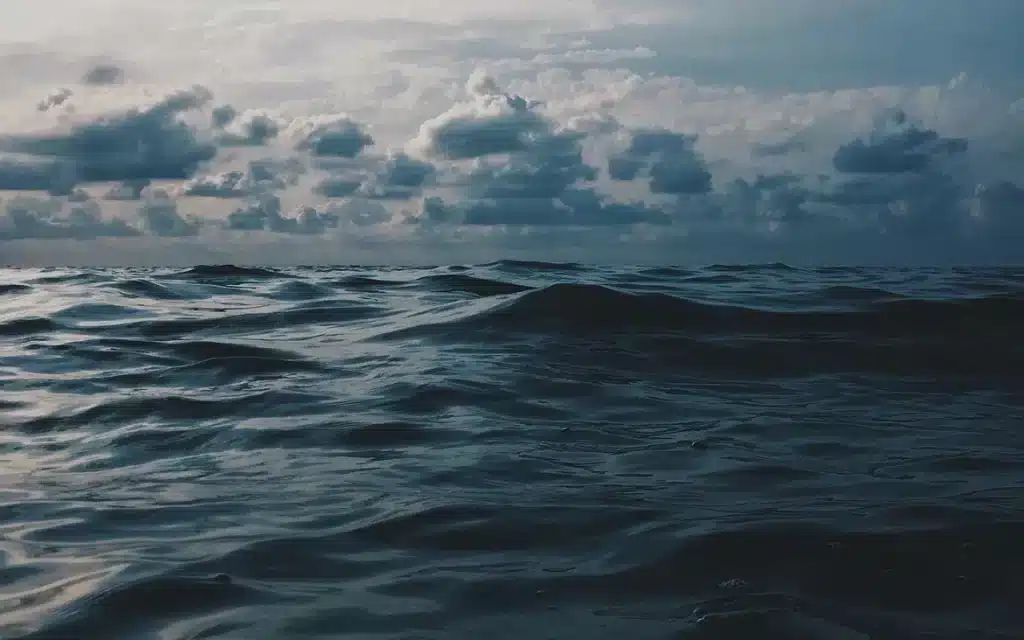
What happens when the wind weakens? Such situations may occur in localized high-pressure areas. Several design characteristics make VELA’s trimaran particularly efficient in light airs. Its stable three-hull configuration allows a large sail area to be carried effectively, maintaining solid speeds even in marginal conditions.
When storms approach, the vessel – designed to safeguard cargo integrity – remains safe and operational. The sail plan can be reduced and adapted to heavy winds. Operating under the French flag, recognised by the Paris Memorandum of Understanding the most demanding maritime safety framework in the world, the vessel complies with the highest international safety standards. In exceptional conditions requiring a delay in port, most of the conventional commercial fleet would be equally constrained.
The advantage of speed
In favourable conditions – winds of 15 to 25 knots – the trimaran reaches its optimal performance window. Such conditions are frequent in the North Atlantic.
Its intrinsic speed also provides a strategic advantage: the vessel can position itself to avoid zones of excessively weak or strong winds, and to seek out the most favourable conditions.
The art of routing

Routing is therefore one of the cornerstones of 21st-century wind-powered transport. It consists in using meteorological data to optimise a trajectory, striking the best balance between distance sailed and speed.
Over the past two decades, offshore racing has refined this discipline to the point where routing has become a major performance factor. VELA inherits from high-level sailing not only hardware innovations, but also advanced routing software and expertise – arguably the most valuable legacy that offshore racing has contributed to modern maritime transport.
Precise ETAs, rapid crossings
Thanks to its speed and advanced routing capabilities, VELA offers average crossing times of under fifteen days, including loading and unloading. The precision of meteorological data processing allows an estimated time of arrival (ETA) to be established to the day at departure, and refined to within half a day during the voyage.
A broader shift in maritime transport
The need to navigate with the ocean rather than against it now concerns the entire international shipping industry. Sailing against winds, currents and tides no longer makes economic or environmental sense.
Faced with rising fuel costs and decarbonisation constraints, major shipping companies are adopting routing technologies originally developed for sailing vessels. Container ships increasingly practice slow steaming and prioritise balanced routes over purely shortest distances.
In this context, wind-powered maritime transport is not an exception but a precursor — a 21st-century solution whose technologies point the way toward more sustainable international trade.
In the face of climate instability
In a context of global climate disruption, VELA is not only a means of reducing greenhouse gas emissions. Sailing navigation also develops and refines the skills and technologies required to manage increasingly complex maritime and meteorological conditions – including the detection of emerging hazards such as icebergs.
Wind propulsion therefore contributes directly to the resilience and safety of maritime transport.

From myth to science: measuring progress
For centuries, weather seemed governed by divine whim. In Greek mythology, Agamemnon sacrifices his daughter Iphigenia to obtain favourable winds for the Greek fleet sailing to Troy.
With VELA, there is no need to invoke the gods. To ensure a fast and reliable service, we rely on the advances of meteorological science and on modern expertise inherited from offshore racing.
The century-long interruption in the commercial use of sailing vessels sometimes leads to comparisons with the last transatlantic clippers. Yet we readily accept that modern aircraft are more reliable and faster than the early planes of the Aéropostale, because we have lived through continuous technological progress.
In the same way, VELA demonstrates that wind-powered shipping is not a return to the past, but the adoption of a solution shaped by progress – and placed at the service of progress itself.
