Global shipping was hit hard by the war that began on February 28th in the Middle East. While a truce has now been announced, the tensions surrounding the global oil supply, maritime routes diverted for security reasons, and their cascading consequences have reminded us how dependent global trade remains on its energy infrastructure.
To build a better strategy for supply chains, it is essential to examine these volatility factors beyond the circumstances we know today. History shows that these crises are not accidents; they reveal that our current energy system is structurally unstable. An end to the war will not bring long-term stability to the shipping sector. Even with a ceasefire in place, rerouted flows, insurance costs, and market uncertainty are likely to persist in the short to medium term.
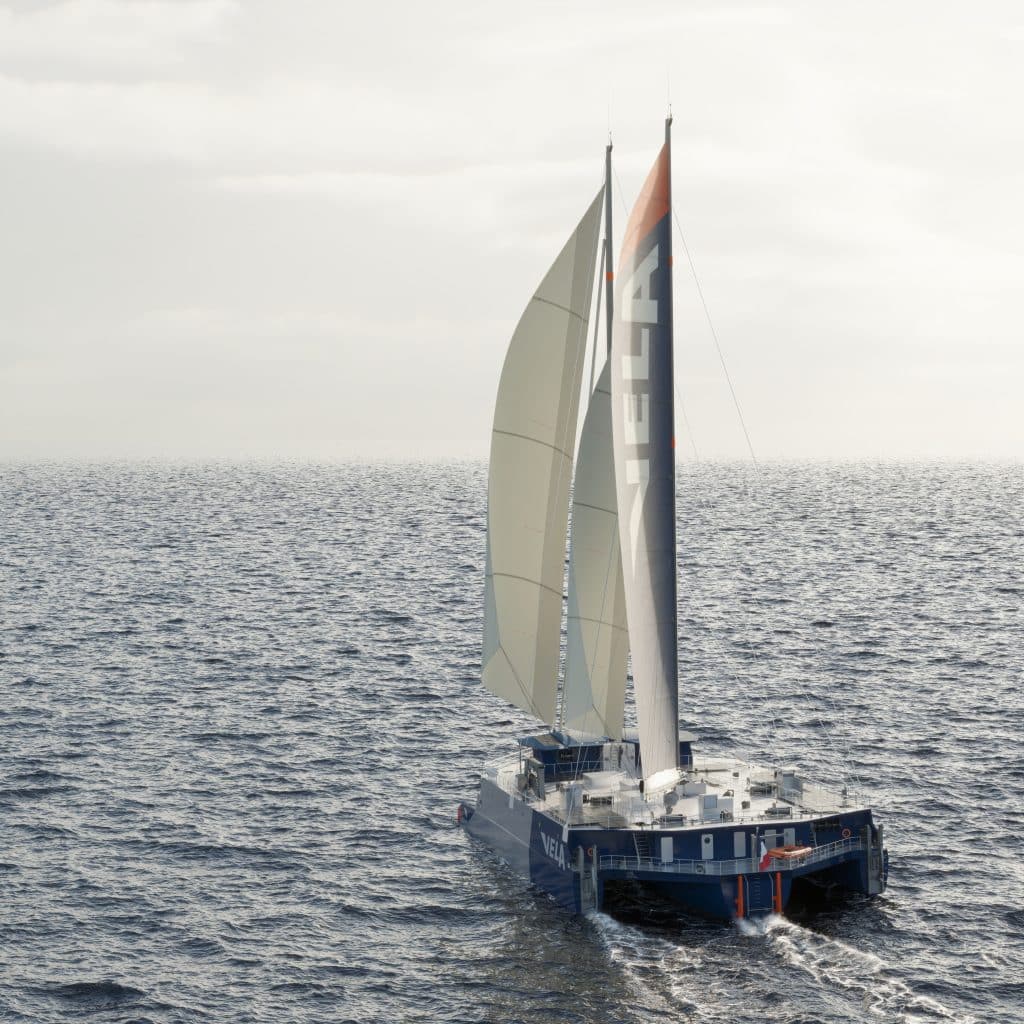
In response, VELA offers wind-powered transport as a predictable alternative. Our model provides fixed prices regardless of oil costs, uses less crowded ports, and avoids the rising expenses of the energy transition.
Stable prices in the face of freight volatility
VELA offers fixed prices for three to five years. This stability provides clear visibility for shippers, standing in sharp contrast to the volatile freight rates seen since the Covid-19 pandemic.
In recent weeks, the Drewry World Container Index has risen once again, despite the typically low activity during this time of year and significant reserves in bunkering ports. It is always difficult to predict how sea freight prices will respond to shocks in oil supply.
In 1967, freight rates soared due to an oil embargo. In 1973, a similar strategy caused the opposite effect, as a global economic slowdown crashed demand.
Current events only reinforce this systemic uncertainty. One thing is clear: maritime freight rates are stuck in a long-term upward trend.
“…one of the most significant supply disruptions in the history of the global oil market.”
There is a clear reason for this: 25% of all sea-borne oil passes through the Strait of Hormuz, where navigation has been significantly disrupted in recent weeks. Due to damaged infrastructure and disrupted exports, Gulf States cut production by about 10 million barrels per day in early March.
As a result:
The price of heavy fuel oil (used by most commercial ships) doubled in just a few weeks.
Prices have surged past $1,000/t at major refueling hubs.
This situation exposes the weakness of our centralized supply chains. It shows how dependent global shipping is on scarce fuels and how quickly energy tensions drive up freight costs.
Three pillars of reliable energy
Fossil fuels have long been valued for their energy density and controllability. However, this apparent reliability masks deeper structural instability in their supply. In contrast, renewable energies—particularly wind—offer a different form of resilience.
Scarcity of fossil fuels, abundance of wind energy
Oil supply is inherently volatile due to its uneven geographical distribution. The recent crisis in the Gulf highlights this concentration risk. Wind, on the other hand, is universally available. It requires no extraction, transport, or geopolitical negotiation—only the ability to harness it. This direct access underpins the price stability offered by VELA.
Supply fluctuations and true intermittency
Wind energy is often criticized for its variability, yet at sea it can be effectively managed through advanced routing and meteorology. By contrast, oil supply depends on geopolitical decisions that are far less predictable. As global reserves tighten and producing regions face long-term decline, this instability is likely to intensify.
Mastering wind energy: performance and agility
Modern sailing cargo ships benefit from advanced design and routing technologies derived from ocean racing. This enables high performance, reliable transit times, and operational flexibility. Unlike fossil fuels, wind does not depend on vulnerable infrastructure or disrupted supply chains.
Disruption of the cost per tonne-kilometer
Beyond energy tensions, the military conflict near the Arabian Peninsula has highlighted how security risks drive up freight prices.
Because of threats in the Red Sea, many ships have been rerouted around the Cape of Good Hope to reach Europe. This detour creates a domino effect on costs:
Longer journeys and higher fuel consumption
Reduced fleet availability as ships are tied up for longer periods
Higher costs per ton across the entire industry
While sail power cannot eliminate global security risks, VELA ensures reliability by choosing safer routes. Its first line operates across the North Atlantic—a wide, open ocean free of major choke points and far from current conflict zones. A full normalization of global shipping routes may, in any case, take time.
Ports under pressure
Redirecting ships away from the Persian Gulf has funneled traffic into fewer routes, causing major port congestion. Large hubs are already overwhelmed and must invest heavily to handle increased volumes, driving up costs.
VELA avoids these delays by using smaller, less crowded ports. This approach decentralizes shipping networks, improving resilience while significantly reducing loading and unloading times.
The climate challenge
Ports and shipping fleets face a major transformation driven by new environmental regulations. The International Maritime Organization (IMO) is pushing toward net-zero emissions by 2050, creating an increasingly strict framework for the industry.
Meeting these goals requires massive investment in new vessels, infrastructure upgrades, and alternative fuels—costs that will likely increase freight rate volatility.
By contrast, VELA’s sailing cargo ships are designed to be low-emission from the outset. This allows the company to avoid many transition costs while positioning itself as a pioneer in sustainable maritime transport.
The true price of war
The shipping industry’s responsibility extends beyond environmental concerns to include social impacts. The recent conflict in the Middle East has highlighted the human risks tied to fossil fuel dependency.
Beyond this specific crisis, it reflects a broader pattern. Many oil-producing regions face challenges related to labor rights and safety standards. The extraction and transport of hydrocarbons often occur under hazardous conditions, and recent ship sinkings in the Persian Gulf underscore these dangers.
Reducing reliance on fossil fuels also means reducing exposure to these risks—both human and geopolitical—and contributing, even modestly, to a more stable and responsible global system.
Blowing in the Wind
In 1962, Bob Dylan was already evoking the wind as an answer to the challenges of his time. Today, wind energy stands out as a credible response to the operational, environmental, and social challenges facing global logistics. The task now is to continue developing technologies capable of harnessing this abundant resource at scale.
With players like VELA, wind-powered shipping is no longer a vision—it is becoming a practical and strategic alternative for the future of global trade.
DHL Global Forwarding France and VELA launch lower-emission shipping solution on selected transatlantic routes, based on indicative lifecycle assessments Villepinte […]
Fossil fuels concentrate energy that is both dense and dispatchable. Wind energy, by contrast, is variable and diffuse. How, then, […]
4 March 2026
Restez informés
de nos dernières actualités
Vous recevrez chaque trimestre notre newsletter pour suivre nos derniers temps forts.
Manage consent
To provide the best experiences, we use technologies such as cookies to store and/or access device information. Consenting to these technologies will allow us to process data such as browsing behavior or unique IDs on this site. Failure to consent or withdrawing consent may adversely affect certain features and functions.
Functional
Always active
Technical access or storage is strictly necessary for the legitimate interest purpose of enabling the use of a specific service explicitly requested by the subscriber or user, or for the sole purpose of carrying out the transmission of a communication over an electronic communications network.
Preferences
Technical access or storage is necessary for the legitimate interest purpose of storing preferences that are not requested by the subscriber or Internet user.
Statistics
Storage or technical access that is used exclusively for statistical purposes.Technical storage or access that is used exclusively for anonymous statistical purposes. Absent a subpoena, voluntary compliance from your internet service provider, or additional records from a third party, information stored or retrieved for this sole purpose generally cannot be used to identify you.
Marketing
Technical access or storage is necessary to create user profiles in order to send advertisements, or to track the user on a website or across websites with similar marketing purposes.