The best way to celebrate the Earth is to act for its preservation.
Established by the United Nations General Assembly, Mother Earth Day celebrates the intimate bond we share with our planet. It is a relationship we have dangerously tended to abuse: seven of the nine planetary boundaries have now been crossed. Beyond the climate, the ocean, biodiversity, soil, freshwater, forests, and the very air we breathe are being disrupted by the pressure of human activity. The equilibrium that sustains our economies and our lives is faltering.
This day exists to remind us that it is not too late to act and preserve these balances. Now more than ever, we have the means to do so. Wherever it is adopted, environmental and social responsibility represents progress. Provided they are respected, ecosystems are resilient. Renewable resources are abundant and can be harnessed efficiently through modern technology. A multitude of concrete, sustainable solutions are emerging in harmony with the Earth’s limits.
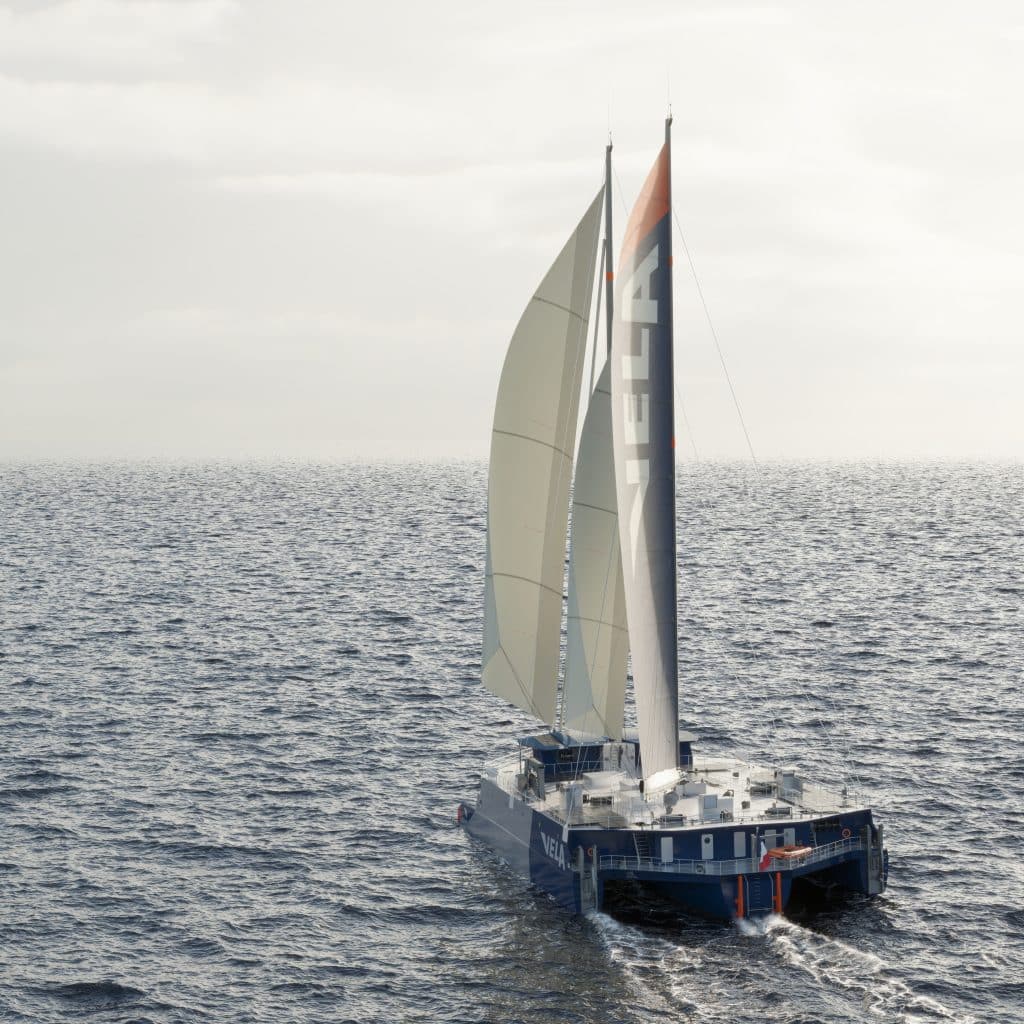
VELA’s mission is to offer such a solution for international transport—one conceived within the full scope of the challenges urging us to act, without compromising on the service provided to shippers. On the contrary.
The Carbon Impact of Shipping
Maritime transport will account for 17% of CO2 emissions by 2050 if we do not act now. This represents a major challenge given that 80% of global trade travels these routes, but it also provides a powerful lever for impact, considering the solutions available to us.
The urgency is well-documented: over the last decade, global temperatures have already reached an anomaly of +1.43°C compared to the pre-industrial era. While the Paris Agreement aimed to limit this warming to 1.5°C, current public policies project us toward a rise of approximately 3°C by 2100. The global fleet particularly impacts the ocean, which absorbs a colossal share of this heat and faces increasing acidification.
Beyond Carbon: The Heavy Toll of Ocean Freight
Furthermore, the sector accounts for 13% of global NOx emissions and 12% of SOx. These atmospheric pollutants, responsible for acid rain that degrades vegetation and waterways, cause major respiratory issues and weigh heavily on the health of coastal populations.
Beneath the waves, noise pollution—which has increased tenfold in 50 years—degrades marine habitats and leads to the fatal disorientation of cetaceans. Every day, nearly 10,000 species travel in the ballast water used to stabilize ships. Discharged far from their native environments, these species circulate through our trade routes, threatening the balance of coastal ecosystems.
A Corporate Responsibility Blind Spot?
According to UNCTAD (2024), over 70% of the world’s shipping capacity is registered under a foreign flag.
According to the International Transport Workers’ Federation (ITF) classification, a significant portion of this fleet (approximately 50% of global tonnage) is registered under flags of convenience. These registries are characterized by a lack of effective oversight by the flag state regarding social standards, as well as higher rates of technical and environmental deficiencies during safety inspections (Paris MoU, 2024).
Consequently, brands that are vigilant about both product manufacturing and working conditions may find themselves confronted, during the maritime transit phase, with social and regulatory standards that do not necessarily reflect their own requirements, in a sector where practices remain inconsistent. Turning to air freight, sometimes considered as an alternative, is not a satisfactory solution: its carbon footprint is, on average, several dozen times higher than that of maritime transport, according to estimates from ADEME (the French Agency for Ecological Transition).
Scarcity of fossil fuels, abundance of wind energy
“To our knowledge, the climate impact of the VELA solution is lower than other possible modes of transport on a similar route.”
This is the conclusion of an independent Life Cycle Assessment (LCA) conducted by the consultancy Carbone 4.
To offer genuine decarbonization, VELA relies on a vessel powered 100% by sail—excluding certain maneuvers—but our commitment does not stop there. In line with the Carbone 4 study, we consider the impact of our ships throughout their entire existence: from construction to recycling, including every phase of use.
The electricity required to maintain the cold chain in our holds, as well as for life on board and navigation, is generated entirely on the ship from renewable energy. To achieve this, we harness the power of the ocean and the sun through two large hydrogenerators and 250 m2 of photovoltaic panels.
Taking into account emissions throughout this operational phase (according to ADEME and Smart Freight Centre standards), the Carbone 4 LCA demonstrates that VELA reduces emissions by:
99% compared to air freight.
90% compared to traditional maritime freight
Notably, the lightweight aluminum used in construction is also infinitely recyclable.
Our Trimaran Preserves Biodiversity
While providing a premium service to shippers, VELA acts on fronts beyond the climate. Our trimaran design offers a level of structural stability rare in cargo transport. Unlike conventional container ships, whose high center of gravity necessitates the massive use of ballast water to counter rolling, VELA eliminates this need entirely. This guarantees cargo safety while marking a victory for marine life by halting the transfer of invasive species.
This protection of life continues below the surface: by prioritizing sail, we drastically reduce the noise pollution that disorients cetaceans. Finally, the absence of heavy fuel combustion eliminates NOx and SOx emissions, directly protecting the health of coastal populations and ecosystems.
Decentralizing Shipping to Reduce the Land Footprint
The sustainable maritime transport that must replace the current, extremely centralized system will be intermodal and composed of multiple solutions. Wind-powered transport, as offered by VELA, is one facet of this—available now and tailored to the needs of shippers.
On land, this new agility allows for operations from secondary ports, closer to production and consumption sites. This approach eliminates thousands of kilometers of road transport while improving the resilience of logistics chains that are currently clustered around congested hubs.
High Environmental Standards, high Social Standards
To structure these commitments, VELA has chosen institutional rigor. Certified by Bureau Veritas and compliant with all IMO international conventions, our vessel flies the French flag. Recognized as one of the most demanding in the world, this flag holds the top spot in the 2025 Paris Memorandum of Understanding rankings, guaranteeing excellence in maritime safety and environmental protection.
April 22nd also leads to May 1st, International Workers’ Day. The high standards of French law strictly govern the living and working conditions on board.
Towards Sustainable Progress
At VELA, our mission is the safe, fast, and predictable transport of the goods entrusted to us.
At the same time, we aim to help demonstrate—by providing shippers with concrete and sustainable solutions—that our societies can strive to flourish while respecting planetary boundaries.
Bibliography
ADEME – Agence de la transition écologique. (s. d.). Base Empreinte (anciennement Base Carbone®) – Facteurs d’émissions du transport de marchandises.
CNUCED – Conférence des Nations Unies sur le commerce et le développement. (2024). Étude sur les transports maritimes 2024. Nations Unies.
IMO – International Maritime Organization. (2020). Fourth IMO Greenhouse Gas Study 2020.
IMO / Global Ballast Water Management Programme. (s. d.). Ballast water as a vector for invasive species. Archive IW:LEARN.
ITF – International Transport Workers’ Federation. (2024). Flags of Convenience: 2024 Global Fleet Analysis.
Paris MoU – Paris Memorandum of Understanding on Port State Control. (2024). Performance list of flag states: White, Grey and Black List.
ScienceDaily / University of Delaware. (2006). Deep-sea Species At Risk From Surface Oil Spills. Consulté sur https://www.sciencedaily.com/
Stipa, T., Jalkanen, J.-P., Johansson, L., Liefvendahl, M., & Vallin, C. (2020). CSHIPP report on air pollution from shipping. Clean Shipping Project Platform (CSHIPP).
UNEP – United Nations Environment Programme. (2024). Emissions Gap Report 2025.
The VELA project was built around a fundamental principle: decarbonization must not come at the expense of operational reliability or […]
10 June 2026
Restez informés
de nos dernières actualités
Vous recevrez chaque trimestre notre newsletter pour suivre nos derniers temps forts.
Manage consent
To provide the best experiences, we use technologies such as cookies to store and/or access device information. Consenting to these technologies will allow us to process data such as browsing behavior or unique IDs on this site. Failure to consent or withdrawing consent may adversely affect certain features and functions.
Functional
Always active
Technical access or storage is strictly necessary for the legitimate interest purpose of enabling the use of a specific service explicitly requested by the subscriber or user, or for the sole purpose of carrying out the transmission of a communication over an electronic communications network.
Preferences
Technical access or storage is necessary for the legitimate interest purpose of storing preferences that are not requested by the subscriber or Internet user.
Statistics
Storage or technical access that is used exclusively for statistical purposes.Technical storage or access that is used exclusively for anonymous statistical purposes. Absent a subpoena, voluntary compliance from your internet service provider, or additional records from a third party, information stored or retrieved for this sole purpose generally cannot be used to identify you.
Marketing
Technical access or storage is necessary to create user profiles in order to send advertisements, or to track the user on a website or across websites with similar marketing purposes.