


Fast, Direct, Highly decarbonized
the transatlantic line between air freight
and ocean freight
Europe – USA
line 100% wind-powered
direct route
No Transhipment. No hub congestion.
30000 pallets / year each way – fleet capacity

<15 days
Target port-to-port

1 sailing / week
Target frequency at full deployment

reliability
More control. More predictability

high security
tailored customer service
across the supply chain

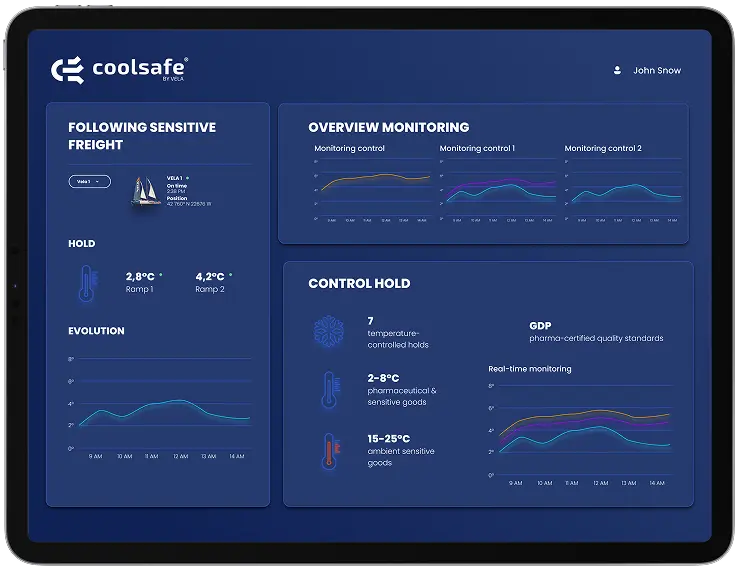
7 temperature controlled holds
35-46°F / 59-77°F

600 euro palets/weeks
Target frequency at full deployment

climate
impact
up to 95% lower propulsion emissions

social
impact
French flag. High social standards for seafarers

biodiversity
impact
0 ballast water. Helps protect
marine ecosystems
built for performance.
designed for impact


END-TO-END TRANSATLANTIC FREIGHT, POWERED BY VELA AND DHL GLOBAL FORWARDING
One integrated offer.
VELA and DHL Global Forwarding combine their expertise to offer a seamless, door-to-door solution from pickup to final destination. A premium service for shippers who demand performance, reliability and a lower carbon footprint.

PICKUP
From your warehouse

EXPORT
CUSTOMS
Clearance & handling

PRE-
CARRIAGE
To the port

OCEAN
TRANSPORT
By VELA sailing trimaran

IMPORT
CUSTOMS
Clearance & handling

POST-
CARRIAGE
To final destination
THE VELA + DHL ADVANTAGE

LOWER-CARBON OFFER
Together, VELA + DHL enable a lower-emission shipping solution on the transatlantic market.

SEAMLESS, FAST & RELIABLE
An integrated door-to-door offer designed to maximize speed, reliability and ease of execution.

PREMIUM SECURITY
Controlled chain of custody and high standards of protection.

DIRECT
ROUTE
No transshipment. No hub congestion. More control.

TAILORED SOLUTIONS
For high-value, sensitive and time-critical goods.
Future VELA expansion
scaling wind-
powered freight
Our first vessel will open the way. With a five-vessel fleet on the Atlantic, VELA aims to provide weekly departures, strong service reliability and up to 48,000 tons of annual capacity between Europe and the United States.
This is only the first step: VELA is building a replicable operating model for strategic routes worldwide, together with partners ready to bring high-performance, wind-powered freight to their markets.

Sustainable cold-chain transport
for high-value and sensitive goods
A highly decarbonized, patented transport solution designed for pharmaceuticals and other temperature-sensitive products.
Some innovations are not immediately visible. CoolSafe is one of them.
At the core of VELA’s vessels lies a next-generation refrigeration system, powered entirely by renewable energy generated on board, enabling a new standard for sustainable transport of sensitive goods.
GDP Pharma–certified holds & SOPs (34-45°F / 59-77°F)
Designed for pharmaceutical-grade performance
Developed in partnership with T.R. Équipements, a specialist in industrial refrigeration, CoolSafe equips the seven temperature-controlled holds of the VELA trimaran.
Each hold is engineered to ensure full compliance with Good Distribution Practice (GDP) standards supported by real-time temperature monitoring and excursion control systems:
- 2 refrigerated holds (34–45°F) for the most sensitive pharmaceuticals and temperature-critical products
- 5 controlled ambient holds (59–77°F) for other essential goods
Decarbonization without compromise
Powered by an autonomous renewable energy system, CoolSafe delivers up to 99% carbon reduction compared to traditional international transport.
With CoolSafe by VELA, pharmaceutical shippers no longer have to choose between sustainability and service reliability
Focus on autonomous Renewable Energy System aboard
The CoolSafe innovation is based on an unprecedented energy integration that allows our batteries to be charged with energy produced on board, guaranteeing the complete autonomy of the cold chain.
New Generation Onboard Solar Production250 m² of latest-generation photovoltaic panels ensure optimized electrical production:
- Maximum efficiency thanks to the maritime surface area
- High-performance marine photovoltaic technologies
- Continuous production adapted to refrigeration needs
Revolutionary Hydro-Generators for Cargo-Sailboats.
The electricity necessary to maintain the cold chain is supplemented by hydro-generators of unprecedented dimensions for a sailboat:
- Optimal exploitation of marine kinetic energy
- Constant energy efficiency during navigation
- Technical innovation adapted to the VELA trimaran profile
Multi-Source Energy Security High-capacity onboard battery system coupled with a biofuel-compatible generator:
- Energy storage for nighttime navigation and unfavorable conditions
- Backup generator using sustainable biofuels
- Absolute cold chain security 24/7

pharma-ready
Design for sensitive goods with 34-46°F and 59-77°F temperature controlled holds

dEcarbonized
Wind-powered maritime transport combined with onboard renewable energy.
“Sensitive goods should not have to choose between reliability and sustainability”
Containers have been ruling goods transportation over the last 50 years.This choice was made for economic reasons but with a high environmental impact, just like air freight.
- #IMPACT: the weight of the containers (3 tons each) accounts for more than 20% of what is being transported on a conventional container ship vs. 2% for equivalent pallets (25kg each). Using pallets enables the transport of goods alone, without useless extra weight. Each pallet represents a reduction of 200kg in weight and the corresponding CO2 emissions.
- #STANDARD: we transport your goods in the same way they were initially prepared at your warehouse in French or US formats.
- #AGILE: You only pay for the goods we transport for you. There are no consolidation fees to compensate empty container management.
- #OPTIMISED: using pallets enables a vessel’s hold to be fully optimised and thus transport more goods than with containers.
We use very advanced weather routing techniques to define the optimal trajectory for each crossing. This allows us to avoid windless areas and areas where the wind is too strong.
These innovative cargo ships coupled with this routing allow us to be faster than conventional container ships (unloading included) on the Caen-New Haven route
It depends on the types of products and the palletizing plan.
We are up to 5 times cheaper than air travel.
For example, for a bottle of mid-range spirits, the additional cost represents a few tens of cents, compared to conventional sea freight.
At VELA, we practice “fair” prices for sustainable and socially responsible transport.