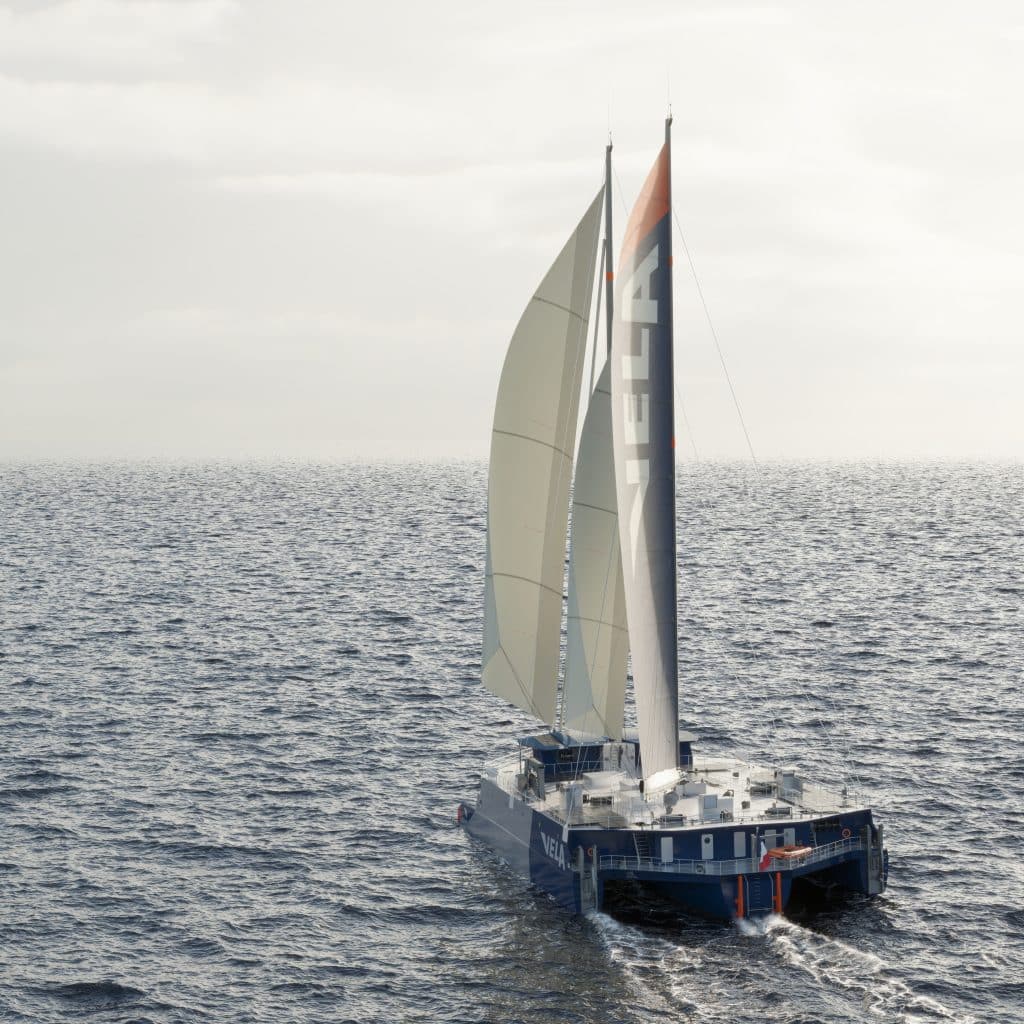
The VELA project was built around a fundamental principle: decarbonization must not come at the expense of operational reliability or service quality. Security, frequency, speed, and the cold chain: on all these fronts, our sailing cargo ships require no compromises from shippers. These high standards, which have earned the VELA 1 the nickname “the airplane of the seas,” open up 100% wind-powered transport to the most sensitive products.
Transporting pallets rather than containers remains an adjustment for some companies accustomed to traditional maritime freight. It is a logistical choice whose technical and operational advantages must be understood, alongside the changes it foreshadows for our supply chains.

As the standard unit of international shipping, the container is both a catalyst for and a symbol of globalization. Its success relies on undeniable operational qualities. However, it also embodies certain limits of this model: the massification of flows, the centralization of infrastructure, raw material consumption, and more. Tomorrow’s transport will likely not do without containers—and there would be little reason to wish for that. The pallet, however, as the elemental link in our supply chains, could play an increasingly important role in our quest for decentralization and resilience.
Lightness: A Factor in Energy and Logistical Efficiency
Choosing pallets as the transport unit takes into account a crucial parameter of sailing: weight. Unlike traditional maritime transport, which offsets this constraint through increased fuel consumption, the performance of a 100% wind-powered cargo ship depends directly on its mass.
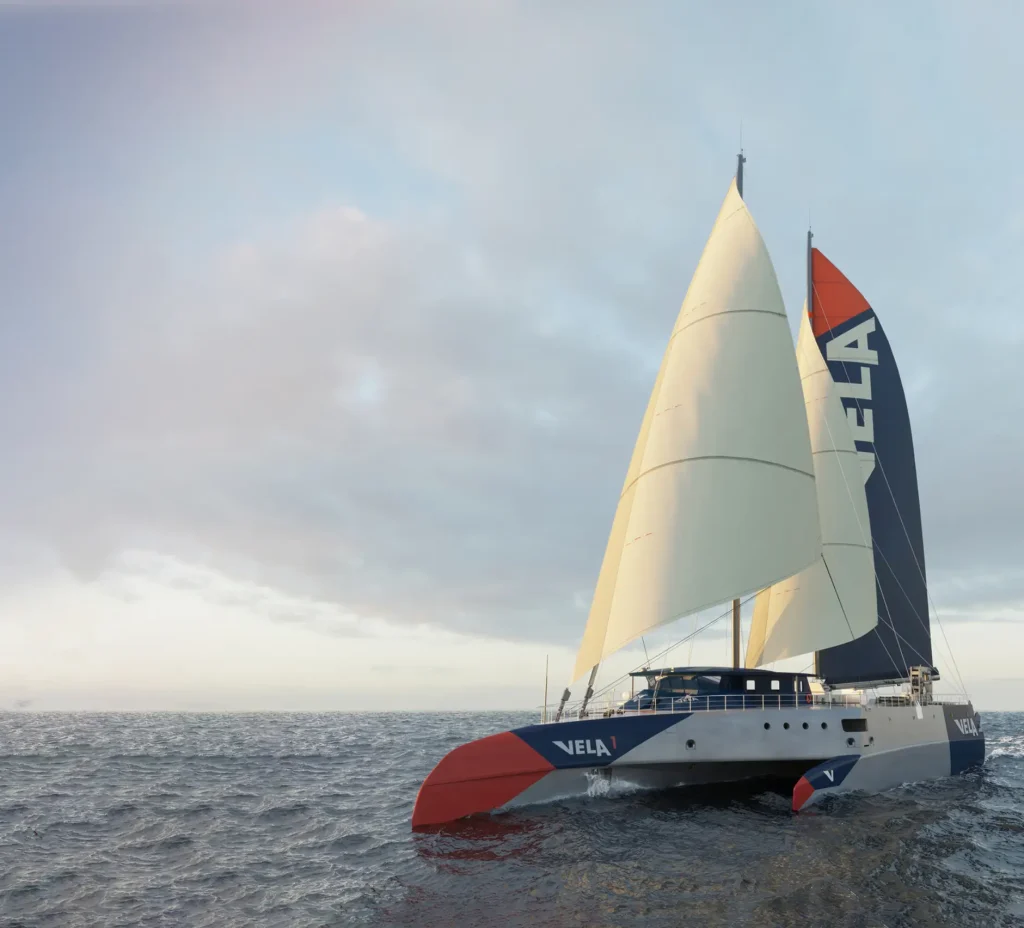
To optimize the performance of the VELA 1 while maximizing its carrying capacity, a major lever involves saving on the weight and volume of containers. By freeing up the space they occupy, the trimaran can load up to 600 pallets, or roughly 410 tons of cargo. If 40-foot containers were loaded on board, their weight would account for 25% of this payload. At an equivalent speed, the carrying capacity would therefore be reduced by a quarter.
Furthermore, speed is not merely an end in itself. It also contributes to the overall transport capacity of the line, well beyond the payload of a single crossing. The figure of 600 pallets – which still represents the equivalent of five cargo planes – was carefully considered by VELA’s technical partners (VPLP and MerConcept). The idea behind this balance: with high speed, the frequency of departures increases, maximizing the ship’s annual transport capacity.
Furthermore, speed is not merely an end in itself. It also contributes to the overall transport capacity of the line, well beyond the payload of a single crossing. The figure of 600 pallets – which still represents the equivalent of five cargo planes – was carefully considered by VELA’s technical partners (VPLP and MerConcept). The idea behind this balance: with high speed, the frequency of departures increases, maximizing the ship’s annual transport capacity.
A Simple and Robust Cold Chain
While the transition to palletized transport may require some adaptations, VELA has designed its service to transform this apparent constraint into an operational advantage—starting with the cold chain.
For the cosmetics, pharmaceutical, or food industries, traditional ocean freight has a point of vulnerability: the reliance on refrigerated containers (reefers). These depend on a continuous electrical supply, which they do not generate themselves and which often comes from carbon-based sources, both on ships and in ports. They therefore rely on complex technical systems whose performance depends on several operational links: power supply, maintenance, port connectivity, etc. Each of these elements is a potential source of failure.

With VELA, the ship itself becomes a thermo-protective shell. The pallets in question are stored deep within the central hull in a fully controlled environment. Coolsafe by VELA, developed with our partner T.R. Équipements, uses renewable energy to power two refrigerated holds (2–8°C) and five temperature-controlled holds (15–25°C), offering sensitive goods a level of care that meets the industry’s highest standards.
Rethinking Logistics from the Shipper’s Perspective
Breaking free from the container is also a way to simplify operations for some shippers at their production sites. For many companies dealing with limited volumes, managing shipments is a delicate balancing act. Waiting for a container to be full before shipping optimizes costs, but at the expense of commercial agility and high inventory levels.
Less than Container Load (LCL) shipping exists to share space with other exporters, but this solution imposes its own constraints, first and foremost being consolidation delays.
This is where palletized transport changes the game. A solution like VELA’s allows you to ship exactly the desired quantity and pay precisely for that volume.

The Pallet at the Heart of Tomorrow’s Transport
With a service tailored to the shipper, VELA may be foreshadowing a profound evolution in the transport sector: that of less centralized supply chains, anchored in local territories and adapted to their specific needs.
Of course, the container is not disappearing anytime soon. It fully belongs in the future of transport. Used wisely and in the right places, massive carrying capacities can serve the goal of decarbonization.
However, the current relationship between mass-transit shipping lines and road transport is likely bound to evolve. Certain studies, such as those by the Shift Project in its Plan to Transform the French Economy, advocate for the development of more agile intermodal networks, relying on a fine-grained geographical grid and low-carbon transport solutions.
In this context, sustainable and resilient transport will entail working more closely with smaller logistical units, such as the pallet.
Protecting the Ocean by Securing Goods
Palletized maritime freight already offers positive environmental externalities compared to the use of containers. Notably, it reduces the pollution risk associated with losing cargo at sea.
According to the International Maritime Organization (IMO), an average of 2,300 containers were lost each year between 2019 and 2022. While this figure may seem low compared to the total volume transported, it represents a real risk – not only for the shippers involved but also for the ocean.
A single lost container can indeed become a major source of pollution for ecosystems. In December 2024, for example, a fallen container led to the dispersion of hundreds of thousands of plastic pellets, which washed up on the shores of the Iberian Peninsula (Le Monde, 2024).
The pallets transported by VELA are loaded below deck in sheltered, watertight holds, completely protected from the weather and the ship’s roll.

Saving Raw Materials and Reducing Emissions

Each container holds several tons of weathering steel, an alloy enriched with phosphorus, copper, chromium, and nickel to improve its corrosion resistance. The production of this steel is a highly CO₂-emitting industry.
According to the IMO, around 250 million containers are transported by sea every year. Behind this flow, the global fleet is estimated at over 40 million units in circulation. The emissions linked to their production are inherently baked into the carbon footprint of maritime transport. Therefore, reducing container use has an impact on the climate and the environment in its own right.
Another frequently overlooked impact concerns wood resources. Container floors, usually made of plywood from tree species selected for their resistance to humid environments, can contribute to the pressure exerted on tropical forests.
Complementary Solutions
These rarely discussed effects of maritime transport remind us of the far-reaching impact of our logistical choices. No single solution is perfect on its own. Pallets, for example, must also be sourced from responsible forestry supply chains.Nor is the container the enemy of tomorrow’s transport. It will retain its full place in a model that will, in all likelihood, rely on the complementarity of multiple solutions. The challenge, then, is not to pit models against each other, but to advance them in order to build a leaner, more resilient logistical system. It is now up to us to make this a reality.
Bibliography
- https://hz-containers.com/fr/actualites/pannes-et-defauts-les-plus-courants-des-conteneurs-frigorifiques/#:~:text=D%C3%A9fauts%20graves%20%3A,dommages%20m%C3%A9caniques%20de%20la%20tuyauterie.
- https://lemarin.ouest-france.fr/shipping/le-naufrage-du-msc-elisa-3-symbole-des-problemes-de-pollution-plastique-dans-les-oceans-94760642-46dd-11f0-be2d-492a352fc811
- https://www.lemonde.fr/planete/article/2024/01/09/un-conteneur-perdu-en-mer-provoque-une-maree-de-granules-en-plastique-sur-les-plages-du-nord-de-l-espagne_6209923_3244.html
- https://www.imo.org/fr/mediacentre/hottopics/pages/faq-plastic-pellets.aspx
- https://wwwcdn.imo.org/localresources/en/MediaCentre/Documents/CCC%209-13%20-%20Estimate%20of%20containers%20lost%20at%20sea%20-%202023%20update%20(World%
- https://infos.ademe.fr/magazine-decembre-2023-janvier-2024/dossier/reduire-le-nombre-de-palettes-en-circulation-dans-le-monde/
- https://www.imo.org/fr/mediacentre/hottopics/pages/container-default.aspx#:~:text=Le%20Conseil%20mondial%20de%20la,sur%20les%20250%20millions%20transport%C3%A9s.
- 20Shipping%20Council%20(W…).pdf